Wooden Flooring, PU/PVC Flooring, Synthetic and PP Tiles Flooring
Provide AMC
No
Service Location Type
Residential Building, Corporate Building, Commercial Building, Educational Institute, Health Care Centre
Service Location/City
India
We are providing Indoor Sports Vinyl Flooring to clients which are known for its perfect and accurate finish. This Indoor Sports Vinyl Flooring has been designed by our experience designers to accommodate a wide range of sporting events. Indoor Sports Vinyl Flooring is known for its smooth finishing.
As per the increasing requirements of the patrons, we are involved in offering supreme quality of Multi-Layered Vinyl Flooring. This Multi-Layered Vinyl Flooring requires less maintenance and easy installing. We provide this Multi-Layered Vinyl Flooring in various dimensions and ensure to satisfy the entire requirements of the clients.
Sports India manufacture Epdm Rubber Tiles for playgrounds, gyms, fitness studio, health centres, walkways.
Epdm rubber tiles are a superior solution for playgrounds and gyms.
The tiles are manufactured environmentally friendly from crumb rubber granules and premium epdm rubber granules on top surfaces.
Epdm rubber granules are design for softness, resiliency and colour fading resistance.
EPDM rubber (ethylene propylene diene monomer (M-class) rubber), a type of synthetic rubber, is an elastomer characterized by a wide range of applications.
EPDM rubber flooring is the best quality flooring by nature.
It involves epdm rubber granules that are self-pigmented in nature. Hence making it last longer than the SBR variant. And they come in brighter colour shades.
Epdm rubber flooring is the next best option after SBR. Its granules are pre-coated with colour and hence the shades available are slightly darker.
Advantages for choosing Sports India epdm rubber tiles.
Epdm Rubber Tiles can be used as multipurpose rubber flooring which are getting popular among clients.
The product feature has the similar compression strength, hardness shore, anti-skid resistance and protection performance is strong.
This can be installed in commercial gyms and playground surfaces like kindergartens, parks and school play areas.
Due to its variety of 18 different bright epdm colours, the commercial gyms have a range which gives a more colour fast finish then SBR rubber tiles and opens a wider choice of colours.
These are also impact absorbing making them suitable for gyms and playgrounds.
These are environment friendly, toxic free, no stimulation to the human body, no pollution, no microbes.
The installation is easy which can be led by polyurethane adhesive.
In recent years we have done a tremendous number of gyms and health clubs which selected epdm rubber tiles over the SBR rubber tiles.
The customer will receive premium quality rubber flooring globally.
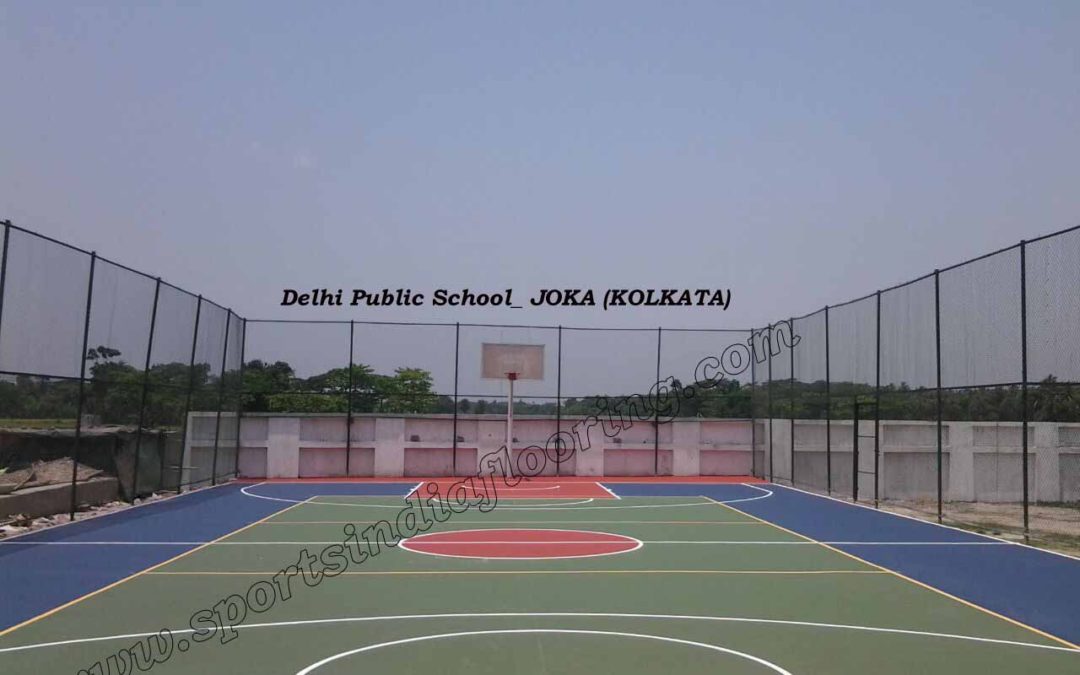
We (SPORTS INDIA) helps to build your dream basketball court from a wide variety of court options such as an indoor basketball court, an outdoor basketball court or a cushioned basketball court. If you are looking to build a basketball court or need a resurfacing and are clueless with what to do and how to answer the questions in your mind, we are ready to give you our best solution for your basketball court project. Sports India has partnered with world top synthetic material manufacturer in world for basketball court surfacing. this materials that provide durability, resistance to weather and resistance of fading to ultra violet rays with a 2 year warranty which is remarkable in the industry.
Basketball court construction basics
The basketball court construction basics vary according to the type of court you want to build, either indoor or outdoor. Most of the basketball professional players use hardwood court surfaces. Basketball courts come in different sizes, they are:
Under FIBA rules, the court is of 92 ft.( 28 meters) by 49 ft. (15 meters)
For NBA & NCAA, it is of 94 ft. (29 meters) by 50 feet (15 meters)
A high school court is of 84 ft. (26 meters) by 50 ft. (15 meters)
Amateur basketball courts vary in a wide proportion.
Apart from the size, the recommended ceiling height is of 27 feet (8.23 meters) and also you can choose your favorite color for the basketball court you want to build from a wide number of color combinations.
Some construction tips to remember :
Choose the suitable basketball court dimensions for your needs.
Level the playing surface by transferring dirt from high areas to low areas.
Make sure the concrete or asphalt is installed per ASBA specifications.
When installing basketball goal footers, make sure they are the proper size for the goal.
Paint the principal lines on your court with a line tape machine.
For safety, insure you have a minimum runoff of 3 feet on the sideline and 5 feet on the baseline .
The basketball court should be oriented from north to south in order to minimize the effect of sun glare while playing.
Make sure that there are no low tree branches nearby that could interfere with shots or passes.
Factors to consider
Condition of land
Condition of land is a crucial factor while choosing land to build a basketball court. So you must choose land which is geologically stable and flat to limit earth movements and support work as much as possible.
Avoid highly reactive clays and prefer compactible soil.
Hire a qualified geotechnical engineer to examine the soil for finding out some problems like expansive soils, high organic material content, and high groundwater conditions.
Sloping & Drainage
Appropriate drainage system is necessary to keep water away from your court surface. Because if uphill water drains into the soil beneath your court, it can damage the court extensively.
Proper slope (max 1%) is needed to allow water to drain away from the court.
Choose a suitable water drainage system from a number of drainage types according to your court location.
Weather
Local weather must be checked while constructing the court because
All acrylic surfaces are prone to damage under harsh temperature and weather.
Too cold (below 50* F) or too hot weather conditions adversely affect the drying process.
Overcast conditions also play a big role in preventing the surface materials from proper drying.
If you are pouring a concrete slab, check the weather to make sure the concrete will be dry before inclimate weather approaches. After concrete has been poured, wait for 36 hours to utilize the court and let the court settle a minimum of 30 days before applying acrylic coatings.
Concrete vs. Asphalt
If we compare Asphalt with Concrete,
Asphalt is an affordable option and comes with a lesser price range than the concrete construction.
The installation process for asphalt is easier than the concrete.
Material costs for asphalt is less expensive than concrete.
If asphalt is improperly built, then it will not last as long as a concrete.
Post Tension concrete, while more expensive, is typically going to outlast an asphalt surface.
Concrete play courts are more durable, low maintenance, and crack resistant than asphalt.
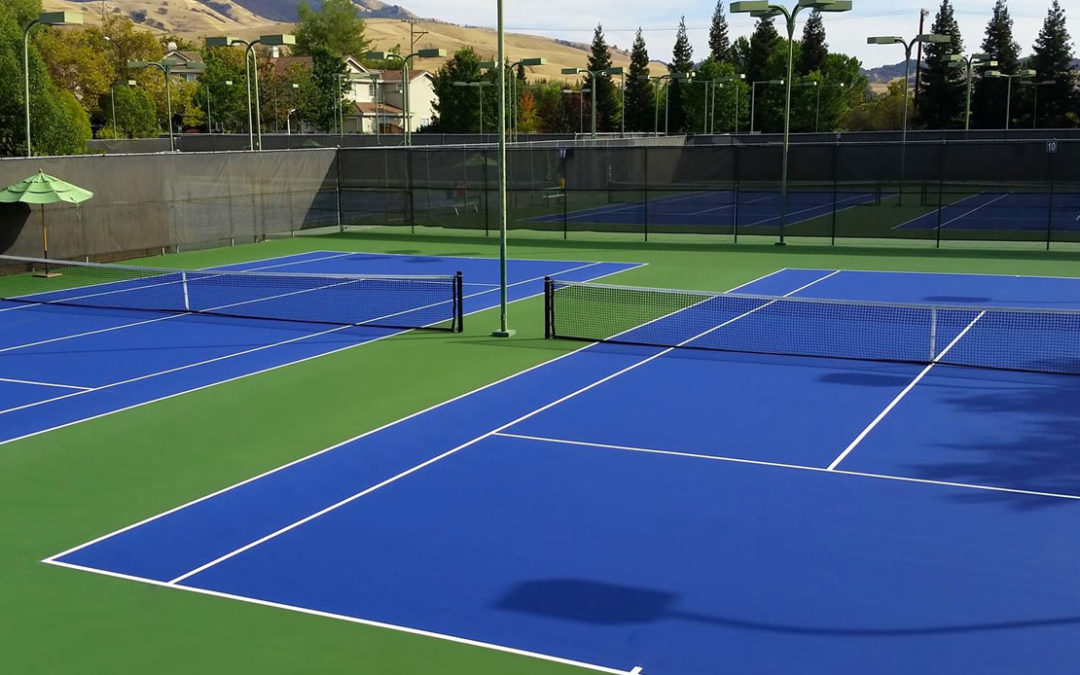
The time and effort expunged in the planning and construction stages of a tennis court will determine the play-ability and longevity of the court in the following 10 to 20 years. A clear section of land for a tennis court needs to measure at minimum 60’ wide by 120’ long. An outdoor court should always have a 1% slope to allow for proper drainage. Tennis Courts, as well as most other sports courts, should be oriented North to South to enable play while the sun is rising in the morning and falling in the afternoon. Base preparation and construction will determine if your court lasts 10 years or 20 years. We recommend using only Virgin Asphalt (thickness of asphalt and sub-base varies by location) or Post Tension Concrete for your substrate. Fencing, Windscreen, Lighting, Net Posts and Nets are all custom options in which your personal taste and budget are the only restrictions.
Factors to Consider Condition of land
The selection of a location where a tennis court is to be built has a large factor in the prep and base cost of tennis court construction. The flatter the piece of land the less expensive the pre-construction earth work becomes. Areas with hills can require large amounts of earth movement and even retaining walls at times.
Drainage
To keep water away from your court surface we always consider how water flows over, under and around your court. Dependent on location we may install drains in addition to the normal 1% slope of the tennis court surface.
Weather
Local climates can prove to be a hindrance on the court construction process. All acrylic surfaces are very temperature and weather sensitive. If it is too cold (below 50* F) or too hot the acrylic surface will not dry properly. Rain or overcast conditions also can be cumbersome as they prohibit the proper drying of the surface materials.
Building Permits
Building, Electrical and general construction permits, costs and their requirements vary by location. Please consult with Ace Surfaces for more information on your specific location.
Concrete Vs Asphalt
One of the most common questions asked in court construction is whether to choose a concrete or and asphalt base for a tennis court. Asphalt, in some locations may be the least expensive option for a court base, however if improperly built will not last as long as a concrete surface. Post Tension concrete, while more expensive, is typically going to outlast an asphalt surface. Concrete Surfaces will be slightly more rough on the body as they are less forgiving/harder than an asphalt surface. Concrete Surfaces will have a slightly higher initial cost for surfacing due to a 2 component primer that is required for proper acrylic adhesion.
Standard Acrylic Surface vs Premium Acrylic Surface
The industry standard surfaces come with a 1 year warranty and 3-5 year life expectancy. Your new substrate has a 1 year warranty and 20-30 year life expectancy. A premium surface selection, such as Laykold Masters, typically has a slightly higher cost but includes a 5 year warranty and 8-12 year life expectancy. Using a premium surface means less down time stakecasino nz, more vibrant/longer lasting colors and less cost down the road.
Cushion vs Hard Court
There are 2 types of cushion surfaces in the tennis court world. A liquid cushion surface (industry standard) is usually applied with squeegees and around 2mm thick. The shock absorption can be anywhere from 2%-5% and will slowly degrade with age. The premium option would be a mat based cushion system. The Laykold Masters mat systems are available in 5mm and 8mm thickness and have 16%-23% shock absorption and will retain their resiliency for 30+ years